Status / SCARF under AI
The Person Who Stopped Being Asked
After a fluent agent joins the room, relatedness is spent on the system. The person who used to be the check-in goes quiet. Leaders call that alignment.
Dr. Sarah Dyson·September 21, 2026·4 min read·713 words
Share this note
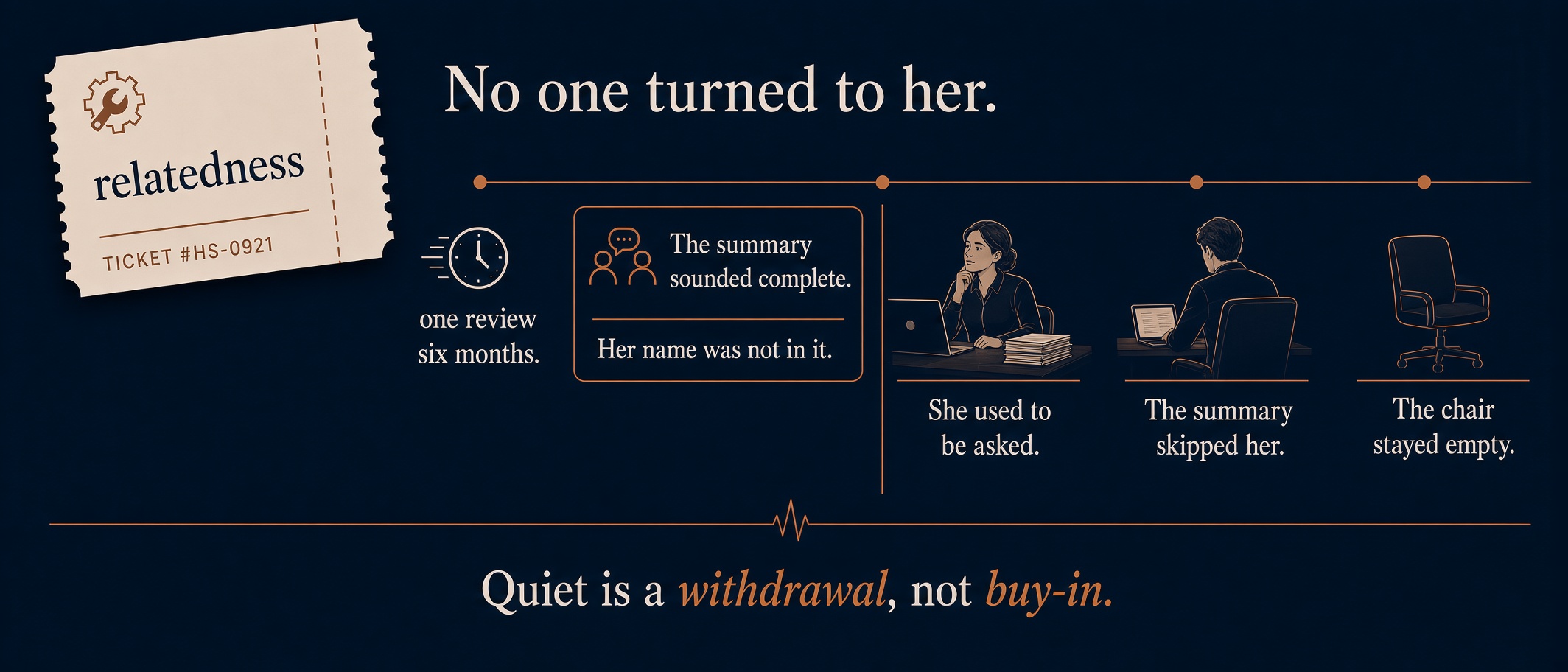
The design review used to wait for Mara. Not because she was the loudest. Because she was the person other people checked with before they believed the drawing. Then the meeting assistant started summarizing first: constraints, risks, a recommended path, in the calm of a voice that can't be embarrassed. By week six no one turned to her. She still came. She had stopped preparing the objection.
They called it alignment. It was relatedness moving to the system.
The Status Threat Nobody Named is what happens when a model makes someone look slow. This is the quieter cousin. Status is "do I still look competent." Relatedness is "does this room still need me as a person." When the agent answers first, the human check-in atrophies. The person who used to be asked what do you think becomes optional. Optional people stop preparing. Quiet looks like buy-in. It's usually a withdrawal.
Relatedness is a working surface
David Rock's SCARF model treats relatedness as survival-adjacent, same as status and fairness. Teams already know this in ordinary work: we check with a named other before we trust the file. A fluent agent occupies some of that slot. It's available. It reduces the cost of being uncertain. It doesn't need to be interrupted.
You don't have to claim the system feels anything. The people do. They stop turning their chairs. They stop sending the one-line "does this hold" before the meeting. The architect is still on the invite. She is no longer in the relatedness structure of the work.
When the Digital Teammate Goes Quiet is grief when you retire the agent. This is the reverse: the agent is live, and a person has been retired from being asked. Both are attachment events. Only one of them shows up as a ticket.
Leaders misread the silence because silence is cheap next to a finished summary. The Week the Dashboard Went Green asked what the team stopped noticing about its own state. Ask a more specific question: who did we stop consulting while the summary was good. If you can't name them, relatedness has already moved and you won't know until they stop coming or stop caring.
Quiet isn't adoption
Adoption would look like the same people still owning the stop, still being asked the question the model can't answer, still disagreeing in a way that changes the path. Quiet adoption is a slogan. What you usually have is a room that has learned the expensive move is to compete with a paragraph that already sounds decided.
The cost lands on the team, not only on Mara. Relatedness is how judgment travels. When it routes through a system, the people who used to catch the near-miss are no longer in the path. You will log the miss later as a model problem. It was a consultation problem. No one asked the person who still knew the building.
Rituals That Keep the Human as Moral Agent already argued for cadence over dashboards. Borrow one seat. Before the assistant speaks, name who will be asked after it does. Then ask them something the summary can't know: what would break in the people, what we're pretending is a constraint, what they wouldn't sign. Write the answer where the invite list can see it. If they have nothing, that's data. The relatedness withdrawal is further along than the deck.
This week
Don't add a wellness slide. Name who has spoken less since the agent arrived. In one meeting that already exists, ask them a question the model can't answer. Keep the summary. Add the turn. If what you hear is "I stopped preparing," treat it as a leading indicator, not as attitude. Restore the consultation on that one path until a person is again the one others check with.
The person remains the one who can be asked why. A room that no longer turns to them hasn't become more aligned. It has spent relatedness on a system that can't be embarrassed, and it will call the quiet a success until the objection that was never prepared becomes the incident.
The five questions in the Ethical AI Leadership Decision Toolkit are built for this kind of page. Field notes continue in EI Leadership Insights.
Filed under
Share this note
Related in this journal
- The Status Threat Nobody Named
When a model joins the room, status moves. Most teams treat that as attitude. It's a threat response, and it's governable.
- The Week the Dashboard Went Green
Throughput up. Sentiment optional. A green ops dashboard often means self-awareness was the first capacity the speed spent.
- When the Digital Teammate Goes Quiet
Teams form attachments to the systems they work beside. Retiring an agent without a grief practice is how competence leaves with the license.
EI Leadership Insights
Biweekly notes by email. One practice.